Author: Abdullah al Mamun, Chief Strategy Officer, TISA
On Saturday, November 15, 2025, the Islamic Seminary of America (TISA) partnered with the Dallas Muslim Medical Alliance (DMMA) for the “Beyond the White Coat” event in Irving, TX. The conference brought together Muslim physicians and healthcare professionals for a day of learning, networking, and discussion on the ethical and spiritual dimensions of medical practice. It was a full day, not just in the schedule sense, but in the sense that you leave reflecting on what you heard, and what it asks of you.
What feels especially important is the value of gatherings like this. Muslim professionals need access to Islamic learning that meets them where they are, not once a year and not only in theory, but in the middle of work, decisions, and responsibility. That is where initiatives like “Beyond the White Coat” become part of a larger vision. Faith-informed continuing education, when done thoughtfully, can be a real service to physicians.
We are grateful to Dr. Rahman Mohammed, President of DMMA, for his leadership and for bringing people together with a clear intention. The program was well-organized, welcoming, and thoughtfully designed, with the right balance of professional development and community connection.
Some of the most meaningful moments happened outside the formal sessions; between the hallways and the lobby conversations, you heard real life come out. I remember overhearing two young physicians talking quietly about residency and how hard it can be to stay consistent with worship when the hours are relentless. No dramatic story. Just honest. That one exchange captured why this conference matters.
Dr. Aasim Padela’s presence was a major highlight. We appreciate him deeply. He serves as visiting faculty at TISA, and many in our community will remember him as last year’s keynote speaker at the TISA graduation. What I respect about Dr. Padela is how he speaks to clinicians. He does not turn Islamic ethics into an abstract lecture. He treats it like a practical lens– something physicians can actually use when decisions feel complicated, and pressure is high.
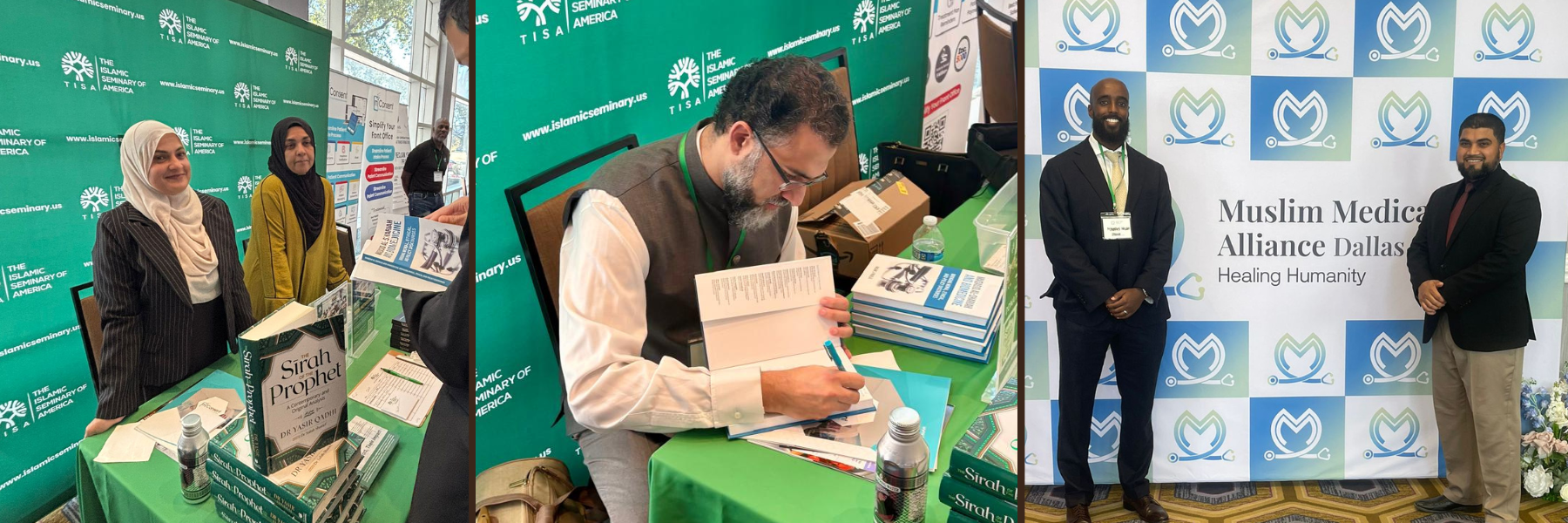
We hosted a book signing with Dr. Padela at the conference. It was simple, but it made the event feel more personal. People came up, asked a quick question, shared a short story, took a photo, and moved on. These brief interactions can be surprisingly impactful. They remind you that scholarship is not only about ideas, but also about access and relationships.
TISA also had a booth at the DMMA event, and it was busy throughout the day. It was supported by dedicated TISA staff and TISA students who took time to welcome attendees, answer questions, and share what TISA is building. We were also delighted to see a number of TISA students and auditors in attendance who are physicians and DMMA members themselves. In many ways, they represent the kind of learner TISA is increasingly serving: professionals who already bring deep expertise, whether in medicine, law, or other fields, and who are seeking a serious Islamic education that complements their work rather than competing with it.
Many of our students already hold advanced degrees and established careers. They come to TISA because they want more than inspiration. They want grounded scholarship, careful reasoning, and the ability to think through real issues with clarity and integrity. TISA is confessional in its commitments, meaning it approaches Islamic learning from within the tradition with clear religious commitments, while maintaining rigorous intellectual inquiry. That combination is exactly what makes spaces like this conference feel like a natural fit.
This type of engagement is not accidental. Under the leadership of Dr. James Jones, Executive Vice President, TISA has become increasingly confident about showing up in spaces where the community needs grounded guidance. The institution has grown in both credibility and capacity, while staying committed to the core purpose of developing Islamic leadership for North America. That steady leadership is part of what makes partnerships like this possible.
TISA’s foundation is graduate education. We offer the Master of Arts in Islamic Studies (MAIS) and the Master of Divinity (MDiv). That is where we form scholars, chaplains, educators, and community leaders who can serve with depth and sound judgment. At the same time, TISA is working toward indigenizing Islam in America by cultivating scholarship, leadership, and ethical frameworks that are firmly rooted in the Islamic tradition and also fluent in the realities Muslims face in this country.
We are thankful to DMMA for welcoming TISA, and we look forward to future collaborations, insha’Allah. This felt like one of those moments where two institutions came together and, for a day at least, made things easier for the people we both care about.