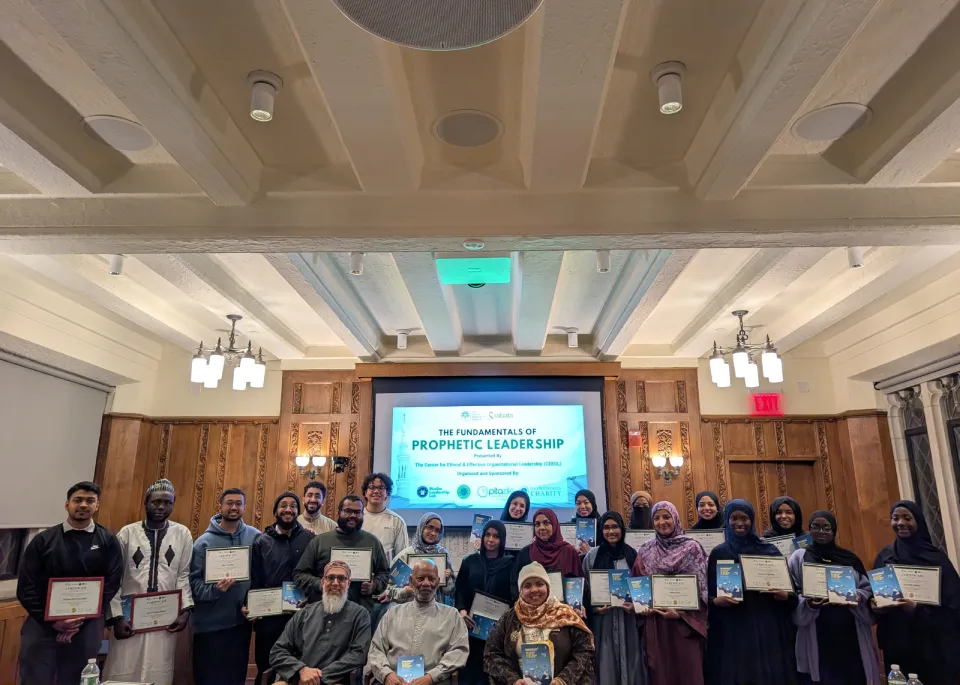
On the weekend of Jan 23rd, 2026, the Center for Ethical and Effective Organizational Leadership (CEEOL), a partnership between TISA and Rabata, had the honor of convening the Fundamentals of Prophetic Youth Leadership short course at Yale University. Dedicated students traveled from across the Northeast, Midwest, and South, despite an approaching winter snowstorm prediction, to gather for an immersive weekend of learning and reflection
The course brought together a highly engaged cohort with diversity that represented the breadth of the American Muslim experience, including South Asian, Arab, African American, Caucasian, European, and mixed ethnicities. Participants represented a wide range of academic pathways, with many coming from STEM, humanities, and professional backgrounds, and hailed from institutions such as Yale University, Wesleyan, Clark, Bowdoin College, Rutgers, among others.
The participants also brought with them a wealth of service and leadership on their campuses and Muslim communities, many serving as MSA presidents and leaders, community Quran and Islamic studies teachers, serving in free clinics and medical missions, leading social justice and advocacy, and youth initiatives and interfaith programming.
Yale provided a particularly fitting backdrop for this short course. Under Chaplain Bajwa’s stewardship, Muslim Life at Yale and the Muslim Students Association have grown from modest student-led prayer groups in the 1990s into a robust, institutionally supported organization offering daily prayers, Jumʿah congregations, weekly halaqas, halal dinners, mentorship, and interfaith engagement. The strong foundation present in the MSA at Yale helped provide the grounding, support, and hospitality present for the short course throughout the weekend.
As one participant shared, “I had a lot of fun working with my team and really benefited from the feedback, using it to improve each time we presented.” The course was led by a seasoned faculty team bringing deep interdisciplinary experience across Islamic scholarship, education, youth, and leadership formation. Instruction was led by Chaplain Omer Bajwa, Director of Muslim Life at Yale, alongside Dr. Mona Islam, who has over thirty years of experience in youth development, and Dr. Jimmy Jones, Executive VP of TISA, with over sixty years of experience teaching at Yale and other institutions of higher learning. Together, they grounded discussions in both scholarship and lived practice, offering careful feedback and mentorship along the way. Participant Nabil Rahman, a senior at Yale College and past MSA president, stated, “We always had the consultation and feedback from the faculty, which really helped in the different projects and presentations that we gave.” Another participant reflected, “The instructors were well prepared and clearly experienced, which made the learning environment both engaging and effective.”
Hosted within Yale’s Humanities Quadrangle, the enclosed wood-paneled classroom welcomed students into a distinctly grounding environment: engraved wooden walls with tall, ornate lead-glass windows, streamed in soft light, curved wooden chairs surrounding the solid oak-toned tables created a serious atmosphere that spoke Ivy League tradition, complemented by modern screens and microphones to elevate learning.
At the heart of the program, the course explored the 11 leadership qualities of the Prophet Muhammad (SAW), offering students a structured framework through which to examine integrity, responsibility, communication, spiritual intelligence, ethical decision-making, and other leadership principles. Short course student Nabil Rahman further stated, “It’s so unique in the way that it’s structured. We covered so much, and I think the curriculum was just so beautifully designed that it was all revolved around one book that we could always refer to.”
The textbook’s content was brought to life through collaborative student presentations that highlighted participants’ strengths, skills, and talents. Student presentations demonstrated both breadth and real-world relevance, ranging from acting-based skits that explored ethical leadership in professional settings, such as selecting employees ethically in an interview, and interactive scenarios involving audience participation, such as solving a murder mystery with justice, to case studies on homelessness and deliberations faced by masjid board members navigating the needs of new Muslim converts. Students brought their own talents to the weekend through Qur’anic recitation, khutbah delivery, adding depth and vitality to the learning environment, and also drew on digital tools and media clips highlighting the Prophet Muhammad’s (SAW) example, as they endeavored to apply Prophetic principles to complex, contemporary challenges.
Participant Fariba Hossain, a student at Yale University, shared, “I feel like I’ve gotten a lot of points on how to apply these leadership qualities in my own life, especially in the organizations I am involved in, especially the servant leadership part.”
Dr. Mona Islam shares, “The students were humble, sincere, and focused. In observing their work, it was impressive to see the sense of community, trust, and engagement forming before our eyes, as students showed genuine care and respect for each other, supported eachothers’ talents and contributions, and brought out the best in each other.”
Students left inspired, grateful, and eager to apply what they explored throughout the weekend in their own local contexts. Nabil Rahman states, “We really were able to work on our inner self and our character, which will inshallah inevitably help us in our leadership as well. I recommend it for anyone who wants to take this short course on prophetic leadership. It’s incredibly valuable, and I think every Muslim needs to take this inshaAllah.”
Participant Yasmeen, a senior at Yale, stated, “ The course gave students a rare chance to learn deeply, ask the questions they had always carried, and practice what Prophetic leadership actually looks like in real life.” Fariba Hossain adds, “I one hundred percent recommend taking this class. I feel like it will teach you a lot of values. Also, it’s very engaging in the workshop format.
Beyond the classroom, congregational prayers and generously shared delicious meals provided moments of care and connection. The weekend was made possible through the generosity and care of our community, sponsors including the Muslim Leadership Lab, the Yale University Chaplain’s Office, PitaZiki Mediterranean Grill, Ali Baba’s Kitchen, and A Continuous Charity, whose support helped create an environment of hospitality, focus, and nourishment throughout the program.
The short course affirmed the importance of cultivating young leaders who are ethically grounded and prepared to serve their communities with wisdom and compassion. Students left not only with practical tools and language for leadership, but with a renewed sense of confidence and responsibility to serve. ”One participant stated, “JazakAllahu khair to everyone who contributed to this event. I am honored to have been able to attend. May Allah grant you all immense rewards and increase you in goodness wherever it may be. You are in our dua’as.” Another student shared, “This was so inspiring, and I intend to bring this knowledge to my community.” May Allah ﷻ bless them as they carry these lessons forward and increase them in goodness wherever they go.
By Dr. Mona Islam (TISA faculty and Board member)