• In-Person Registration: $150
• Online Registration: $50
• Includes Digital Course Materials
• Certificate of Completion awarded upon 100% attendance (In-Person Only)
Choose your preferred learning format and secure your spot:
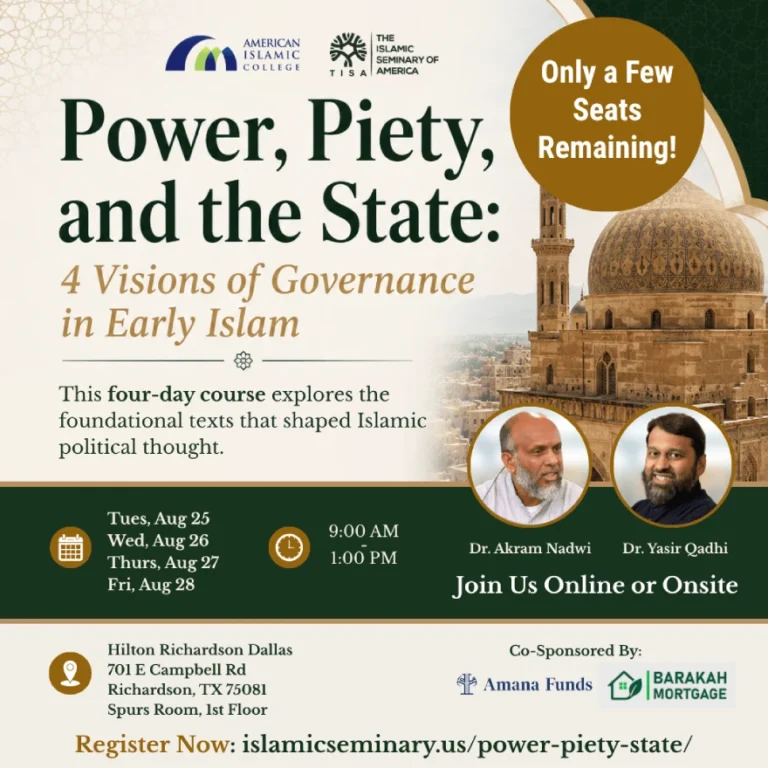
In an age where questions of power, justice, and leadership dominate global conversations, how did the earliest Muslim thinkers imagine the state?
This four-day course offers a guided exploration of foundational texts that shaped Islamic political thought across its intellectual tradition. From philosophical visions of the ideal city to the pragmatic wisdom of kingship, participants will engage with key works such as Risāla fī al-Ṣaḥāba, Kitāb al-Kharāj, al-Madīna al-Fāḍila, and Siyāsatnāmeh. Rather than treating these texts as historical artifacts, the course reads them as ongoing conversations about authority, justice, and the moral purpose of governance.
Whether your background is in history, political theory, or Islamic studies, this course is designed to challenge and deepen your understanding of how faith and power intersect—and what it truly means to govern.
Shaykh Dr. Mohammad Akram Nadwi is one of the most distinguished Islamic scholars of our time. Widely recognised for his depth of learning, intellectual rigour and lifelong service to Islamic scholarship, he has authored, edited and taught extensively in the fields of ḥadīth, fiqh, Arabic language, tafsīr, Islamic history and the intellectual heritage of the Muslim world.
Born in Jamdaha, a village in Jaunpur, Uttar Pradesh, India, Dr Akram grew up in a home where reverence for the Qurʾān, language, and learning formed part of daily life. His father was a ḥāfiẓ of the Qurʾān and possessed foundational knowledge of Persian and Arabic. From an early age, Dr Akram developed an intense love of reading, immersing himself in works of Persian, Urdu, history, and Islamic learning. This early attachment to books became one of the defining features of his life. Learn more about him
Shaykh Dr. Yasir Qadhi, born in Houston, Texas to Pakistani parents, is a renowned Muslim scholar and theologian, deeply committed to the pursuit of Islamic knowledge and academic excellence. His educational journey began with a degree in chemical engineering from the University of Houston, where his involvement with the MSA and giving khutbahs and lectures inspired him to leave engineering and studying Islam. In 1995, he began his ten-year stint at the Islamic University of Madinah, where he finished a diploma in Arabic, a BA in Hadith Studies, and an MA in Islamic Theology. Learn more about him
Your sponsorship helps make high-quality Islamic education accessible to students and supports the development of future leaders grounded in knowledge, ethics, and service. We offer multiple sponsorship levels to enable individuals, families, and organizations to participate meaningfully. Click here for Patron Sponsorship
By sponsoring this course, you are: