Reflections on the “Dialogue of Abrahamic Faiths” Course
Written By Sumiyyah Hye (Graduate Student, TISA)
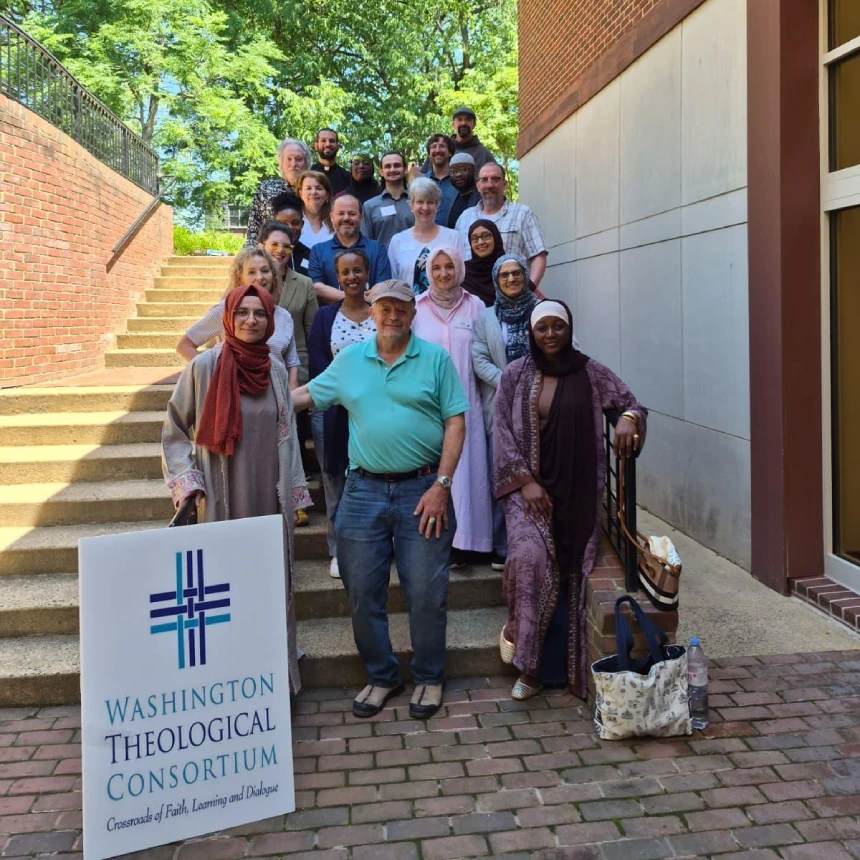
Imagine being whisked away to a breathtakingly beautiful seminary in Alexandria, Virginia, for the sole purpose of engaging in religious dialogue for five entire days. The Washington Theological Consortium hosted its annual course, Dialogue of Abrahamic Faiths, wherein twenty seminary students were invited to partake in the all-inclusive, intensive, and thoroughly immersive learning experience. Having been given over six hundred and fifty pages of an assortment of readings from various authors as a precursor to the course, students from the world’s three Abrahamic faiths (Muslims, Christians, and Jews) arrived prepared for a no-holds-barred event designed to break down barriers in the spirit of promoting
true understanding.
5 Days of Discussing, Observing, Partaking, and Connecting: Upon settling into the simple yet comfortable student housing provided, students spent the first day getting to know one another. Icebreakers infused lightheartedness into what may have been perceived by the students as an
intimidating environment. Introductions to the three resident professors were made, wherein it was clear that the highest of academic standards would be upheld, priming the atmosphere to be one of factual accuracy and welcomed curiosity.
Friday, being the Muslim day of Jum’ah, was reserved for a field trip to a local mosque (which was a restored Church, nonetheless!). Attendees were able to listen to a short yet powerful sermon about a story of Ibrahim, peace and blessings be upon him (how fitting for an “Abrahamic” faiths course!), and the significance of this month of Dhul Hijjah. Invited to stand in the congregational rows with the Muslims,
the students were able to experience what many called “full body worship”. Afterwards, a private session with the imam himself, who had the foresight to realize that answering questions rather than lecturing would be of most use.
Saturday being the Jewish holy day, or Sabbath, students had the opportunity to visit a local synagogue, witnessing prayers in Hebrew. Welcomed warmly by the female cantor, they were shown to their seats and were given individualized copies of chumashim and siddurim, from which they could follow along. As an added bonus, students were able to attend a Bar Mitzvah, where they witnessed the community gather to welcome, support, and encourage the newest responsible male in their midst.
Sunday being the Christian holy day, students were taken to a local Melkite Church. Surrounded by brilliant icons and rich, aromatic incense, they were able to gaze upon religious art and observe Church rituals such as the partaking from the Eucharist, individual blessings given by the priest, and harmonious a capella musical traditions. Afterwards, the class was given a private tour of the Church, including
the baptismal font and iconostasis, where the head priest himself spoke and answered questions in a friendly, Bostonian accent.
Each day included three freshly cooked meals, which students and instructors enjoyed together, seated side by side. Every meal was initiated by a student-led prayer inspired by his or her specific faith tradition, to be shared by all. Days ran from 8:00 am until 10:00 pm or later. Classes were taught by highly
qualified instructors, which included ample question/answer sessions, brilliant visuals, and thought-provoking group activities. Nightly “circle time” discussions, followed by optional outdoor bonfires, were opportunities where students could relax and tell campfire stories, comfortably express grievances or discuss topics of contention, and connect to one another on a deeper level.
What made this interfaith experience so momentous?
The Attendees Themselves
Every student was educated; most were at the master’s level and beyond. Passionate about all things religion, the sincerity with which they engaged was strikingly obvious. This, in turn, enhanced dialogue that was not fraught with your run-of-the-mill ignorance or fear-mongering agendas, saving precious time in which a higher-level discussion and greater understanding could be achieved.
The Structure of the Course
By building up camaraderie on the first day and immediately immersing students into each faith tradition’s place of worship, initial barriers were broken down. Students began to understand and see other viewpoints, having partaken in each other’s faith traditions. Hours of structured classes, where learned professors educated on the fundamentals of each religion, diminished ignorance and fostered
critical thinking. This culminated on the fifth day, a day that delved into controversy, a day where the “elephant in the room” was finally discussed. And this was handled seamlessly yet productively, because by then, mutual understanding and a sincere hope of goodwill for brethren in faith had been achieved.
Week-Long Immersion and Seclusion
Most interfaith events are short-lived sessions that may span a few hours at most. The average interfaith experience confirms that most of these attempts achieve a surface-level politeness riddled with apologetics, emphasizing only coexistence and an albeit sincere desire not to offend. The Dialogue of Abrahamic Faiths course, however, cocooned students in a “sacred” bubble, if you will, away from the distractions of real life (not unlike friars or monks!). Given the opportunity of being able to focus and talk about the most important thing in their lives for five days, the fourteen-hour days flew by. And not a cellphone in sight! A priest, a rabbi, and an imam walk into a room…A friar dressed in a tunic and capuche, a priest donning a black clergy shirt with Roman collar, and a Muslim wearing her abaya and hijab. Anyone looking on from the outside would have assumed them to be a group of “religious stiffs”, ready only to discuss classical texts in heated debate. Miraculously (pun intended), the gift of humor was bestowed on the students as well as the professors, easing dialogue and fostering relatability. In fact, not a day, not even an hour, went by without smiles and laughter.
The Aftermath…
One night, two students went out to get marshmallows for the bonfire. Upon returning, they proclaimed: “Imagine what it must’ve looked like! A friar and priest went up to the unsuspecting clerk at the store and asked for halal marshmallows for their Muslim friend!”
It was in that moment that everyone simultaneously laughed and then fell into a moment of contemplation and realization over the glowing embers of the bonfire: the true bond of brotherhood had unsuspectingly manifested. It was also at that moment that it was lightheartedly proposed that if the subdeacon in the group ever became Pope, he would invite his newfound friends to the Vatican, and this would set an example for world peace. As students bade final farewells, they prayed sincerely for the welfare, guidance, and happiness of one another. Such heartfelt invocations -traversing religious
bounds- gave hope to all those present.
Moving forward, the students have linked up on social media, sharing their own sermons, talks, holiday greetings, and views on current events, among other things. Indeed, lifelong empathy, dialogue, and reverence have been initiated in a true interfaith spirit. Alhamdulillah!